


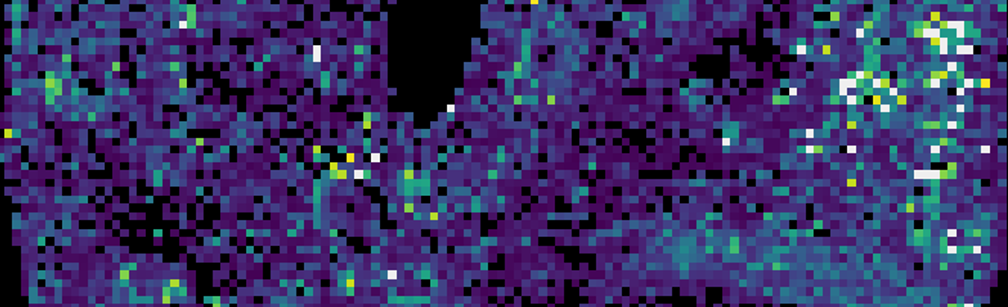
IR-MALDESI is a cold ionization source meaning that it allows the detection of labile molecules (e.g., N-linked glycans containing sialic acids). The method has high salt tolerance, can measure non-flat samples, performs qMSI by spatial calibration curves or VxV, allows for the direct analysis and mass spectrometry imaging of samples, can do ablation-based 3D imaging, parallel reaction monitoring (PRM) imaging, biophysical studies, and does quantitatively sampling. Derivatization or use of secondary lasers is never required for IR-MALDESI mass spectrometry imaging.
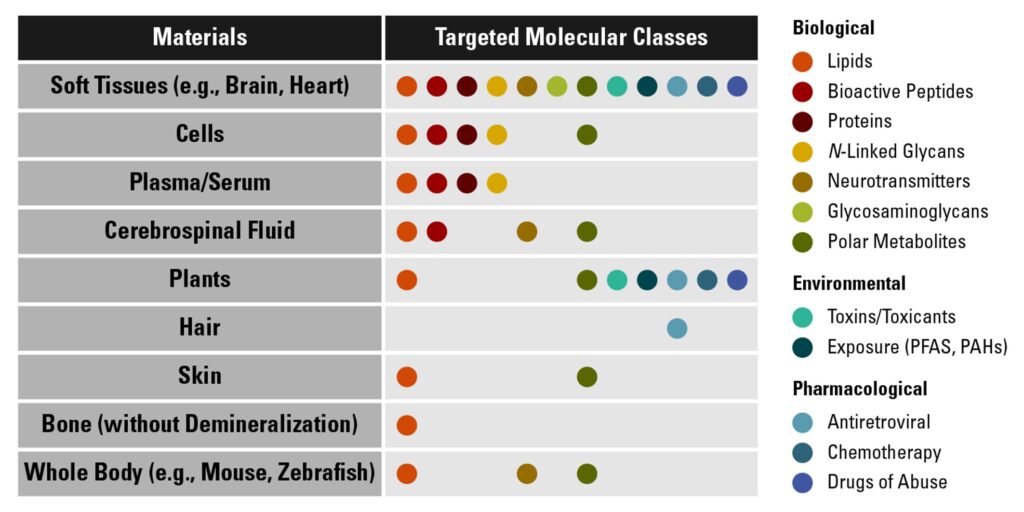
The publications below describe the principles, advancements and applications of IR-MALDESI for a diverse range of projects. This strong foundation has been built over the past 20 years as we unraveled the mechanisms, defined how “soft” the method is, demonstrated 2D and 3D imaging, created novel approaches for matrix applications, demonstrated transmission-mode IR-MALDESI, carried out imaging of non-flat samples using a confocal aberration probe, quantitative MSI (qMSI) using both spatial calibration curves as well as voxel-by-voxel strategies, and countless examples of the impact to biological systems.
Finally, the NextGen IR-MALDESI source is completely controlled with our software platform RastirZ, is now available as a research grade source. In other words, you have to have a significant background in mass spectrometry to confidently operate the source – keeping in mind that one can upgrade to a newly designed source that will be turn-key when it becomes available. This cost-effective upgrade path is done at our company but re-uses the expensive components. The papers discussing the fundamentals and applications of IR-MALDESI should be cited as deemed appropriate. Click on the link after each citation to see who is citing these publications.